

The Magic of this, call(), apply(), and bind() in JavaScript
A beginner-friendly guide to how this changes with the caller and how call, apply, and bind control function context

Introduction
In JavaScript, this is one of those concepts that can feel a little magical at first.
The reason is simple:
the same function can behave differently in different situations because this can change.
And then we have:
call()apply()bind()
These three methods give us control over the context in which a function runs.
What this Means in Simple Terms
A beginner-friendly way to think about it:
Think of this as "who is calling the function."
In other words, this can change depending on the context from which the function is called.
It is not the perfect formal definition, but it is very useful for building beginner intuition.
this Inside Normal Functions
Inside a standalone function, this does not feel as simple as it does inside an object method.
function showThis() {
  console.log(this);
}

showThis();
Here, the behavior of this can feel different depending on the environment and the way the function is called.
For now, just remember this:
- in a normal function,
thisis not automatically tied to a specific object
this Inside Objects
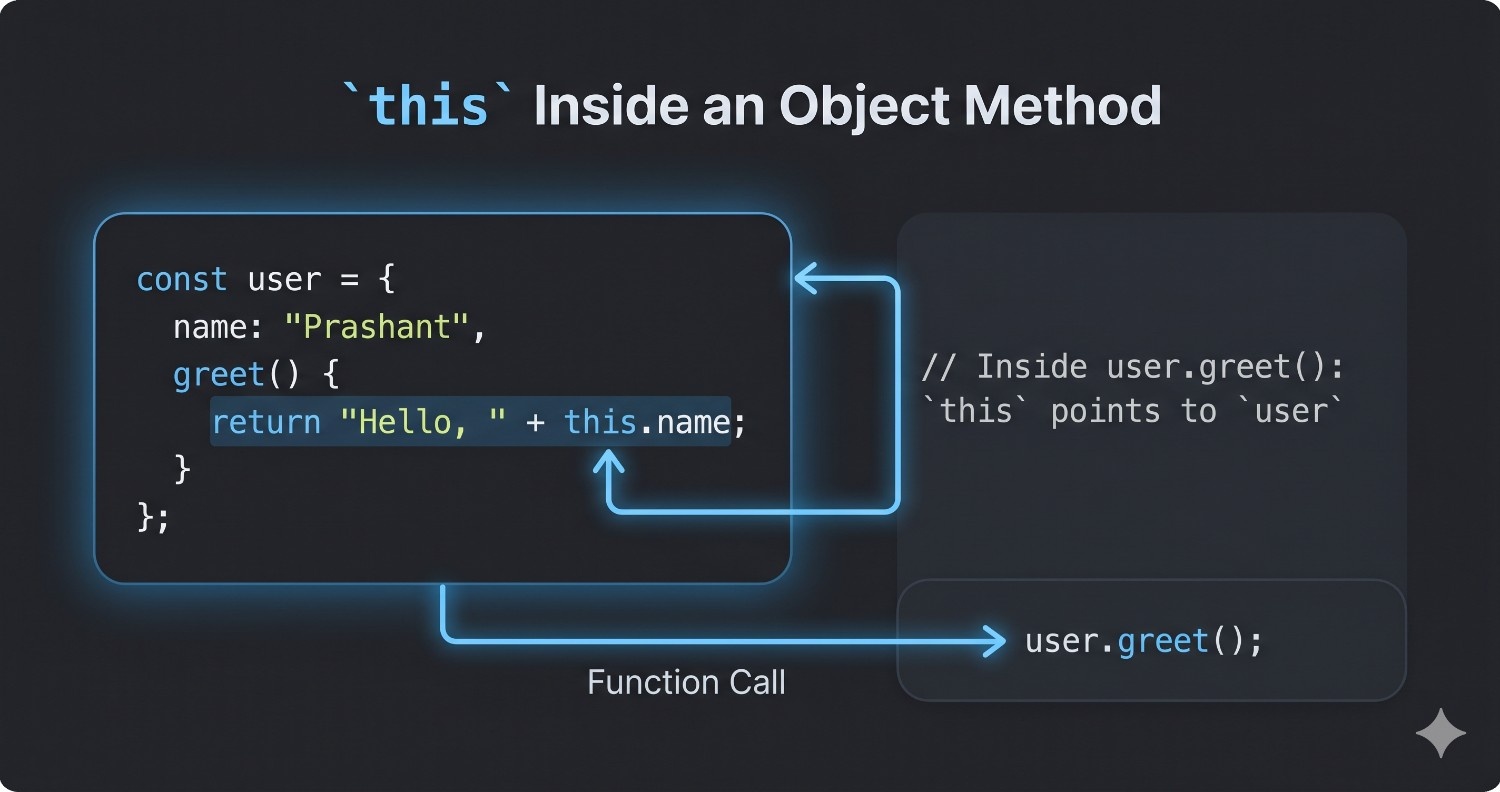
Inside an object method, this feels much more intuitive.
const film = {
  name: "Bajirao Mastani",
  lead: "Ranveer",
  introduce() {
    console.log(this.lead + " performs in " + this.name);
  }
};

film.introduce();
Here, this refers to the object.
Why?
Because the method was called through the film object.
The Caller Idea Again
From this example, remember one simple rule:
film.introduce();
Here, the caller is film.
That is why this inside the method is connected to film.
This basic idea makes call(), apply(), and bind() much easier to understand later.
What call() Does
call() lets us manually run a function with a specific object as its context.
Example:
function cookDish(ingredient, style) {
  return this.name + " prepares " + ingredient + " in " + style + " style";
}

const sharmaKitchen = { name: "Sharma Ji's Kitchen" };

console.log(cookDish.call(sharmaKitchen, "Paneer", "Mughlai"));
Here:
cookDishis a normal functionthrough
call(), we madethispoint tosharmaKitchen
Simple meaning:
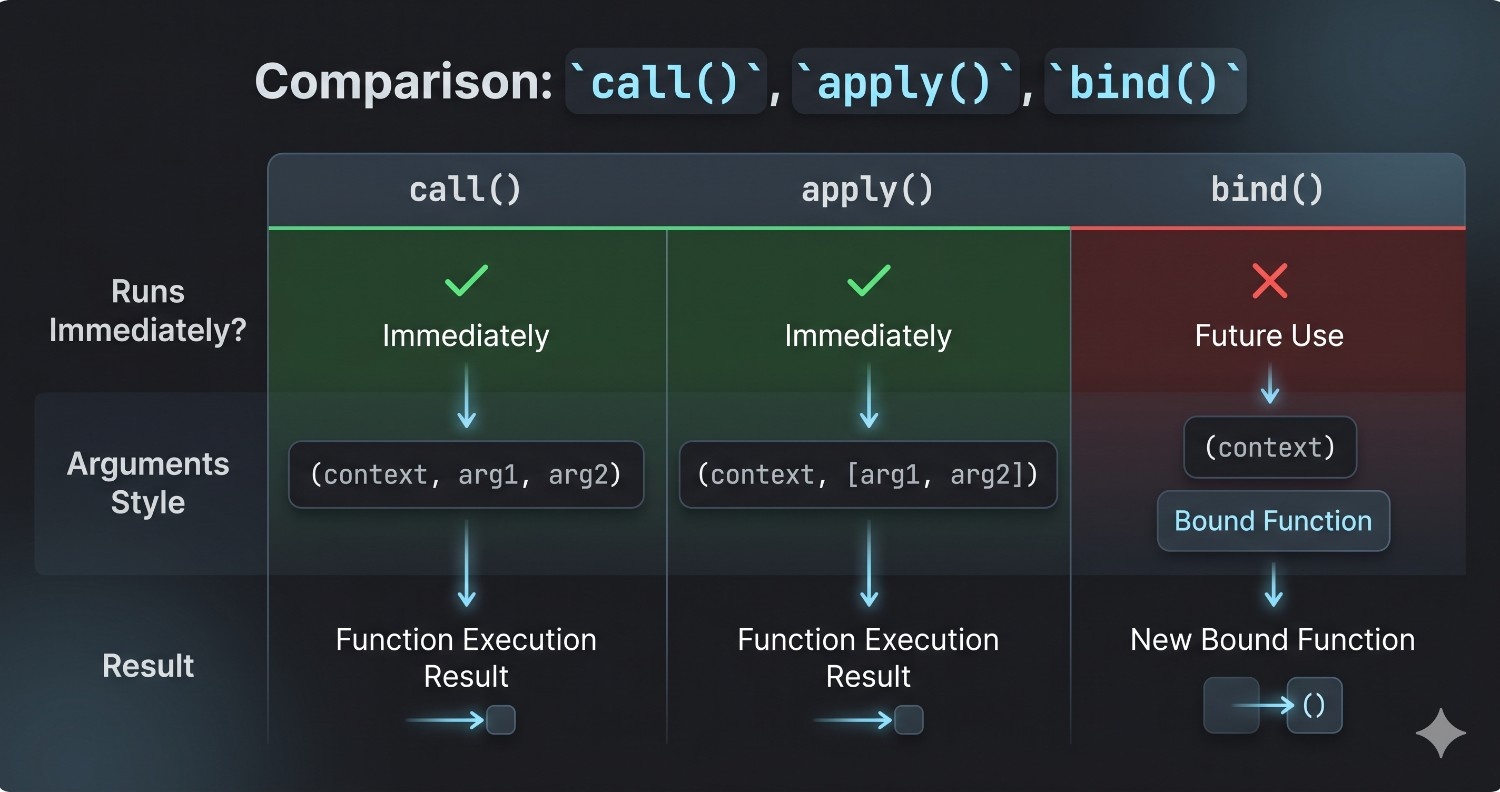
call() runs the function immediately with the given context
What apply() Does
apply() works almost the same way as call().
The main difference is how the arguments are passed.
Example:
function cookDish(ingredient, style) {
  return this.name + " prepares " + ingredient + " in " + style + " style";
}

const guptaKitchen = { name: "Gupta Ji's Kitchen" };

console.log(cookDish.apply(guptaKitchen, ["Chole Kulche", "Punjabi"]));
Here, the arguments are passed in an array-like form.
Simple meaning:
apply() also runs the function immediately, but it takes arguments in an array-like form
What bind() Does
bind() is a little different.
It does not run the function immediately.
Instead, it returns a new function with a fixed this value.
Example:
function reportDelivery(location, status) {
  return this.name + " at " + location + ": " + status;
}

const deliveryBoy = { name: "Ranveer" };

const boundReport = reportDelivery.bind(deliveryBoy);

console.log(boundReport("Haridwar", "Delivered"));
Here, bind() returned a new function whose context was already set.
Simple meaning:
bind() creates a bound function for future use
Difference Between call, apply, and bind
| Method | Runs Immediately? | Arguments Style | Return |
|---|---|---|---|
call() |
Yes | one by one | function result |
apply() |
Yes | array-like | function result |
bind() |
No | one by one while binding | new function |
This table is very useful for beginners.
A Small Borrowing Example
Method borrowing is a very practical use case for this topic.
const actor = {
  name: "Ranveer",
  bow() {
    return this.name + " takes a bow";
  }
};

const anotherActor = { name: "Vicky" };

console.log(actor.bow.call(anotherActor));
Here, the original method belonged to the actor object, but with call() it was used with another object.
That is the basic idea of method borrowing.
A Small Practice Assignment
Try this:
Create an object with a method that uses
thisUse that same method on another object through
call()Pass array arguments with
apply()Use
bind()to store a function and call it later
This practice makes the difference between this and these three methods much clearer.
Summary
at the beginner level,
thiscan be understood through the callerthiscan feel different in normal functions and object methodscall()runs a function immediately with a given contextapply()also runs a function immediately, but takes arguments in array formbind()returns a new bound function that can be called later
Final Thought
this, call(), apply(), and bind() can seem magical at first.
But once the basic idea of caller and context becomes clear, the topic starts to feel much less mysterious.
Continue Reading
Previous: The
newKeyword in JavaScript


